Introduction
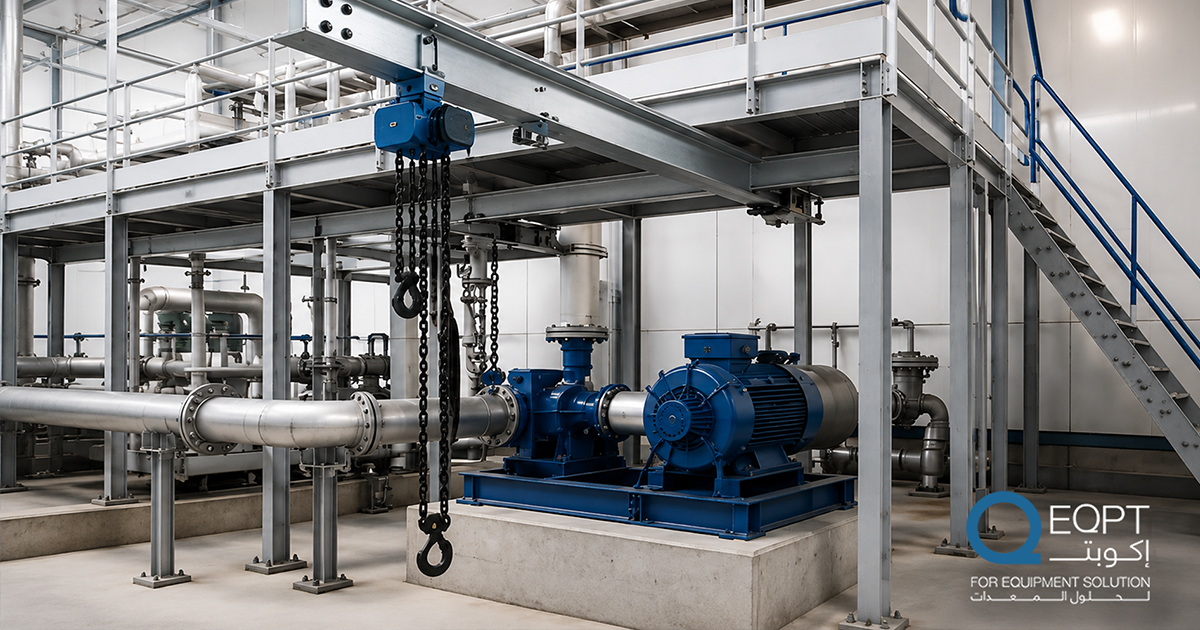
A pump replacement that should take four hours takes fourteen, because the platform above it was never designed to allow a chain hoist to be rigged directly overhead. A valve inspection that should be a fifteen-minute walk-up becomes a scaffold job every single time, because the original access ladder terminates eight inches short of the landing it was meant to serve. None of this shows up in a commissioning report. It shows up two years later in a maintenance budget that’s consistently running over plan, for reasons nobody can quite point to.
Access design is one of the few categories in plant engineering where a mistake made once — at the drawing stage — gets paid for repeatedly, every time a technician needs to reach the equipment it was supposed to serve. Unlike a process design error, which usually surfaces immediately, a poor access design decision can remain invisible for years, silently adding labor hours, safety risks, and schedule delays to routine maintenance work.
Illustrative Cost Model:
Take the rigging example above. If a missing overhead lifting point adds a conservative 6 extra hours per major pump/motor removal (rigging temporary chain falls, verifying anchor points on adjacent structural steel, dismantling and re-erecting scaffolding), and a mid-sized plant has 3–4 such removal events per year across its rotating equipment population, that’s 18–24 additional technician-hours annually from one platform’s design gap. Multiply across 6–8 similarly affected platforms in a typical plant and the annual avoidable labor cost — at a fully loaded technician rate, which varies by contract and region — runs into the tens of thousands of currency units per year, before accounting for the improvised-rigging safety exposure at all. This is a planning-stage decision with a compounding operating-budget consequence.
Why Access Design Gets Deprioritized
Access systems — platforms, walkways, ladders, davit arms, hatches — are frequently finalized late in the design process, after process equipment layout is locked. That sequencing is understandable; access has to be designed around equipment, not the other way around. But it also means access design inherits every constraint left over from earlier decisions, with little room to push back. The result is a category of design that’s treated as a compliance checkbox — “is there a way to reach this?” — rather than an operational cost driver: “how long will it take to reach this, safely, with the right tools, for the next twenty years?”
This sequencing problem is structural, not just cultural: on most EPC schedules, access and structural steel packages are issued for construction after mechanical equipment layout freezes, which means the access engineer is solving a geometry problem with no leverage to ask for more clearance. The fix isn’t necessarily changing the sequence — it’s building a maintenance-task review into the access design step before that package is frozen, not after.
Common Access Design Mistakes and Their Long-Term Cost
Insufficient Clearance for Maintenance Tools, Not Just People

An access platform can satisfy walking clearance requirements and still fail operationally if it doesn’t allow for the hoist, cart, or lifting equipment actually needed to service the equipment beneath it. This is one of the most common and costly mistakes: platforms designed for personnel access only, with no consideration for how a pump, motor, or membrane element will actually be removed once installed.
- A platform without an overhead lifting point forces technicians to rig temporary chain falls from adjacent structural steel — adding hours and introducing an improvised rigging risk each time, often onto structural members that were never assessed or certified for that load.
- A hatch sized for a person but not for the largest component that will ever need to pass through it turns a planned replacement into a partial disassembly of the platform itself.
Engineering Note — Lifting Point Design Factor:
Where a platform is meant to serve as a permanent lift point, the lifting beam, monorail, or padeye should be engineered and certified with an adequate design factor — commonly in the range of 4:1 to 5:1 against the maximum intended working load, consistent with the design-factor principles in ASME B30.20 for below-the-hook lifting devices. An improvised rig to adjacent structural steel has neither a certified working load nor a documented design factor, which is precisely the exposure a permanent, engineered lift point is meant to remove.
Ladder and Stair Configuration That Ignores Frequency of Use
Fixed ladders are acceptable for infrequently accessed equipment. For access points used daily or weekly — sample points, dosing skids, filter housings — a ladder instead of a stair adds cumulative labor time and fatigue that compounds over the life of the asset. The decision to use a ladder versus a stair is often made on space and cost grounds alone, without weighing frequency of use against long-term labor cost.
Engineering Note — Where the Ladder/Stair Line Actually Sits: Fixed ladders with an unbroken climb exceeding roughly 7.3 m (24 ft) generally require a cage, well, or ladder safety device under OSHA 1910.23 — a threshold worth checking against even where local code follows a different but comparable standard. Stairs are typically specified with a rise angle in the 30°–50° range versus a ladder’s near-vertical 75°–90°, which is the practical reason stair travel is faster and less fatiguing for repeat use — not just a comfort preference. Neither of these is the deciding factor on its own; frequency of use is. As a rule of thumb, access points used more than roughly once per shift are worth the stair, even where a ladder technically satisfies code minimums.
Corrosion-Inappropriate Materials in Coastal and Chemical Environments
In desalination and water treatment environments — high humidity, saline atmosphere, chemical dosing areas — access structures made from unsuitable materials (untreated carbon steel, inadequately coated systems) begin corroding within the first few years. GRP (glass-reinforced plastic) and properly specified stainless steel are standard for a reason: the incremental material cost at installation is small compared to the cost of re-fabricating a walkway or platform mid-asset-life because the original structure corroded to the point of failing a safety inspection.
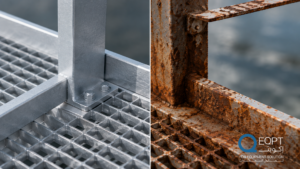
Engineering Note — Corrosivity Category Matters More Than “Coastal”: Under ISO 12944 (protective paint systems for steel structures), a site directly exposed to marine spray or chemical dosing atmosphere is typically classified C5 (very high corrosivity, industrial or marine) rather than the more benign C3/C4 categories often assumed at design stage. Uncoated or under-specified carbon steel in a C5 environment can lose section at a materially higher rate than the same steel in a C3 environment, and recoating intervals in C5 service are correspondingly short — often in the 5–10 year range even with a correctly specified system, versus a 20–25+ year service life typical of properly resin-selected GRP (vinyl ester or isophthalic resin, chosen for the specific chemical exposure, not a generic “marine grade” default). The design decision that matters isn’t “steel vs. GRP” in the abstract — it’s confirming the corrosivity category the structure will actually see and specifying against that, not against the plant’s general classification.
Inadequate Lighting and Fall Protection Integration
Access points designed without integrated lighting or properly positioned tie-off anchors force maintenance work to be scheduled around daylight or require temporary safety equipment setup for every visit. This is a recurring theme across access design mistakes: the incremental cost of doing it right at design stage is almost always smaller than the recurring cost of working around it for years afterward.
Engineering Note — Fall Protection Isn’t Optional Detailing:
Guardrail systems are typically specified with a top rail height around 1.07 m (42 in), per the guardrail criteria in OSHA 1910.29, with a mid-rail at roughly half that height — a detail worth confirming explicitly on platform drawings rather than assuming the fabricator will default to it. Where guardrails aren’t practical and personal fall-arrest is used instead, anchor points need a documented rating — commonly a minimum of 22.2 kN (5,000 lbf) per person for non-certified anchors, or an engineered rating tied to a defined safety factor against maximum arresting force for certified systems (the ANSI Z359 fall-protection series covers this in more detail than most access packages reference). A tie-off point with no documented rating is a liability finding waiting to be discovered during the next safety audit, not a completed design.
Platform Layout That Blocks Future Equipment Changes
Plants change over their operating life — pumps get upsized, additional dosing skids get added, membrane racks get reconfigured. Access platforms designed tightly around the original equipment footprint, with no allowance for future modification, frequently need to be partially demolished and rebuilt when equipment changes, turning a straightforward equipment upgrade into a structural project.
Building in dimensional and load margin at design stage — commonly 15–25% additional footprint and live-load capacity beyond the immediate equipment envelope, where site constraints allow — is a small incremental structural cost relative to the cost of cutting and re-welding an existing platform mid-operation, especially where hot work permits, process isolation, and production downtime all stack on top of the fabrication cost itself.
Missing or Poorly Placed Sampling and Inspection Points
Access to sample points, pressure gauges, and inspection windows is sometimes treated as secondary to access for major equipment. In practice, these are the access points used most frequently — daily or multiple times per shift — and a poorly placed sample point (too high, too far from a stable platform, requiring a harness for a routine task) generates disproportionate cumulative labor cost relative to its size. A sample point positioned outside a comfortable reach envelope from a stable platform doesn’t just cost time — it’s also a leading contributor to the kind of awkward-posture strain injuries that ergonomics guidance (NIOSH-type lifting and reach criteria, applied loosely to access design) is meant to prevent, even though most access packages never reference that guidance directly.
Underestimating Access Requirements for Cleaning and Chemical Handling
CIP skids, chemical dosing areas, and tank cleaning access points need to account for spill containment, ventilation, and the physical space required for cleaning equipment — not just personnel movement. Secondary containment around dosing and CIP areas is commonly sized to hold a defined fraction above the largest single vessel’s volume (a widely used convention in chemical storage design is 110% of the largest tank), and access layout needs to leave the containment berm and drainage path clear rather than treating it as available floor space for platform stanchions. Access designed only for inspection, without accounting for the equipment and space needed for periodic cleaning, forces workarounds that increase both labor time and safety exposure.
Comparison: Access Design Approach vs. Lifetime Cost Impact

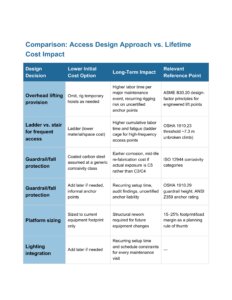
Access Design Decision Framework
Two quick decision checks worth applying before a platform package is frozen:
Ladder vs. Stair
- Is the access point used more than roughly once per shift? → If yes, default to a stair unless site constraints make it genuinely infeasible.
- Is the unbroken climb height at or above ~7.3 m (24 ft)? → If yes, a ladder requires a cage, well, or ladder safety device under OSHA 1910.23 — factor that cost into the ladder option before assuming it’s cheaper.
- If neither condition is triggered and space is genuinely constrained, a ladder is acceptable — but confirm pitch and rung spacing against the applicable fixed-ladder standard, not just “similar to what’s elsewhere on site.”
Material Selection
- Confirm the actual corrosivity category (per ISO 12944) for the specific location — not the plant’s general classification. Proximity to chemical dosing, splash zones, and prevailing wind direction relative to the coastline all shift the category.
- If C5 or marine/chemical-industrial: default to GRP (resin selected for the specific chemical exposure) or marine-grade stainless; budget carbon steel recoat intervals at 5–10 years if carbon steel is used regardless.
- If C3/C4 and genuinely dry/inland: coated carbon steel is typically adequate, but revisit if the plant’s process footprint changes (e.g., a new dosing area added nearby).
Engineering Recommendations:
- Design access around the maintenance task, not just the equipment. Ask what tools, lifting equipment, and clearance the actual maintenance procedure requires — not just whether a person can reach the location.
- Specify lifting points with a documented design factor (commonly 4:1–5:1, consistent with ASME B30.20 principles) wherever a platform is meant to serve major equipment removal — don’t leave that decision to field improvisation.
- Weigh access frequency against access type using the decision framework above, rather than defaulting to whichever option is cheaper to fabricate.
- Confirm the actual ISO 12944 corrosivity category for each access structure’s specific location, not the plant’s general environmental classification.
- Document guardrail heights and anchor point ratings explicitly on drawings (OSHA 1910.29 / ANSI Z359 principles), rather than assuming default fabrication practice will comply.
- Build in 15–25% dimensional and load margin for platforms serving equipment likely to be upsized or reconfigured within the asset’s operating life.
- Treat sample points and inspection access as primary design elements, positioned within a comfortable reach envelope from a stable platform — not wherever space allows after major equipment access is finalized.
- Keep containment berms and drainage paths clear of platform stanchions when laying out access in chemical dosing and CIP areas.

Conclusion
Access design mistakes rarely cause a single dramatic failure. They cause a slow, compounding accumulation of labor hours, safety workarounds, and structural rework that shows up in the maintenance budget rather than the incident report — and, sooner or later, in an audit finding tied to an uncertified anchor point or an under-specified guardrail. For plant owners and EPC teams, treating access design as a maintenance-cost and compliance decision — governed by the same load tables, corrosion categories, and design factors used everywhere else in the plant — is one of the highest-leverage, lowest-cost interventions available at the design stage.
Call to Action
EQPT Solutions designs and delivers industrial access systems — platforms, walkways, ladders, and davit arms — engineered specifically for water treatment and desalination environments, with lifting points, guardrails, and material selection specified against the actual exposure and load conditions on site. If your plant’s maintenance access is driving up labor time or safety exposure, our team can review your current layout and recommend targeted improvements.
FAQ
Q: Why does access design affect long-term maintenance costs?
Access design determines how quickly and safely technicians can reach equipment for routine and major maintenance. A poorly designed access point adds labor time and safety workarounds every time it’s used, and that cost compounds over the operating life of the asset — a missing overhead lifting point alone can add several hours to every major equipment removal.Q: What materials should be used for access platforms in desalination plants?
Material selection should follow the site’s actual ISO 12944 corrosivity category, not a generic “coastal” assumption. Areas directly exposed to marine spray or chemical dosing atmosphere are typically C5 (very high corrosivity), where GRP with a chemically appropriate resin or marine-grade stainless steel is standard; coated carbon steel may be adequate in genuinely lower-corrosivity (C3/C4) areas.Q: Should access platforms include overhead lifting provisions?
Yes, for any platform serving equipment that will need to be removed for maintenance or replacement. A permanent, engineered lift point — designed with a documented safety factor (commonly 4:1–5:1, per ASME B30.20 principles) — removes both the labor time and the safety liability of rigging to uncertified structural steel.Q: When should stairs be used instead of ladders for plant access?
Stairs are generally justified for access points used more than roughly once per shift, even where a ladder would satisfy code minimums, because the cumulative labor time and fatigue cost of frequent ladder use outweighs the modest additional space and cost of a stair. Fixed ladders with an unbroken climb of 7.3 m (24 ft) or more also typically require a cage or ladder safety device under OSHA 1910.23, which narrows the cost gap further.Q: How does access design affect future plant upgrades?
Platforms sized tightly around current equipment footprints often require structural rework when equipment is upsized or reconfigured later in the asset’s life. Building in 15–25% dimensional and load margin at the design stage avoids most of that rework.Q: What is the most overlooked access design element in water treatment plants?
Sample points and inspection access are frequently under-prioritized relative to major equipment access, despite being used far more frequently — often multiple times per shift — and despite being one of the more common sources of awkward-posture strain when placed outside a comfortable reach envelope.