Why Does One Setting Not Fit Every Season?
A multimedia filter is usually commissioned with one backwash flow, written on the data sheet or set at the control valve (on many valves, such as the Clack WS series, the backwash flow is fixed by a drain-line flow control washer rather than by a program setting), and that number is then used all year. The water being used for backwash does not stay at one temperature, and temperature changes viscosity, which changes how far the media bed lifts at the same flow. A media filter backwash rate that is correct in one season can under-clean or over-expand the bed in another. The same applies to any media filter backwash, including every multimedia filter backwash, whether the bed is sand only or sand and anthracite.
This article explains how backwash rate and water temperature interact, what guidance says about expansion targets, and a practical way to measure and adjust the backwash on site.
Why One Backwash Rate Does Not Fit Every Season

Backwash works by lifting and expanding the media bed so trapped solids can be released and carried to drain. The lift comes from the drag the upflowing water exerts on each grain, and that drag depends on viscosity. Colder water is more viscous, so at the same flow it lifts the bed further. Warmer water is less viscous, so the same flow lifts it less.
A rate set to give correct expansion in winter can therefore under-expand the bed in summer. Operators then see rising differential pressure between cycles and shorter runs, and the cause is often not linked to the season. In Saudi plants, check the temperature of the wash water itself: where backwash is drawn from an above-ground treated-water tank, it can be warmer than the filter feed in summer, and it is the wash-water temperature that sets expansion.
What Backwash Is Supposed to Achieve
Drinking water filtration guidance states that the bed should expand by at least 20% during the high-rate wash. Media suppliers publish their own figures; Clack’s Birm data sheet, for example, specifies a minimum backwash bed expansion of 20–40% of bed depth. The right figure for a specific filter depends on the grain size and density of the media, so the sand filter backwash flow rate and the anthracite sand filter backwash flow rate are not the same number, and the media supplier data should be the reference.
How Changes Bed Expansion
Water viscosity falls steadily as temperature rises. Standard reference values are shown below.
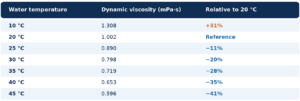
Percentages are calculated from the viscosity values and rounded. Between 20 °C and 40 °C, the viscosity falls by roughly one third. No single universal factor converts a backwash flow from one temperature to another, because expansion depends on the grain size, density, and shape of the specific media. This is why the recommended approach is to measure expansion on site instead of applying a fixed multiplier.
Under-Expansion vs Over-Expansion
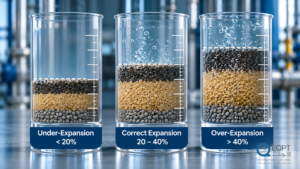
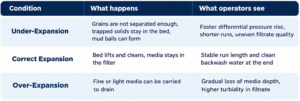
Some filter media loss is normal. Drinking-water operator guidance (the 2005 Watertap newsletter, hosted by the Oregon Health Authority) treats losing up to an inch of media per year as normal, so a faster loss is worth investigating.
How to Measure Bed Expansion on Site

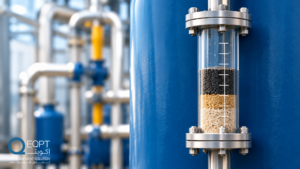
Guidance recommends checking expansion during the high-rate wash, and at least seasonally. A simple method follows.
- Record the water temperature during the backwash.
- Measure the media depth at rest, from the top of the bed to a fixed reference such as the manhole or top flange.
- During the high-rate wash, measure the distance from the same reference to the surface of the expanded bed, through a sight glass if the vessel has one. Most closed pressure filters do not; in that case, catch a sample of the backwash drain at the end of the high-rate wash in a bucket or sieve and check for media, and track the resting bed depth over time.
- Calculate expansion as the increase in bed depth divided by the resting depth, and compare it with the target from the media supplier.
- Repeat when the water temperature changes materially, at least seasonally.
Always follow site safety rules for work on pressurized vessels, and never open a vessel that is under pressure.
Practical Engineering Considerations
- Record the expansion measured at the coldest and the hottest operating conditions.
- If the control valve and backwash supply allow it, adjust the backwash flow between seasons and log the change.
- If the flow cannot be adjusted, check whether the fixed rate gives acceptable expansion at both extremes, and consider this when selecting the backwash pump and valve.
- Keep records of expansion, temperature, run length, and end-of-run differential pressure. A trend tells more than a single reading.
- Check the vessel temperature rating as well as the media: Pentair Structural composite vessels, for example, are rated to 150 psi and to 49 °C or 66 °C depending on the construction (see the Pentair spec sheet for the model supplied).
The EQPT Perspective
Backwash behavior depends on the whole assembly: the vessel and its distributor, the media, the control valve, and the backwash supply. EQPT supplies Pentair Structural composite vessels, Clack control valves and filtration media. When specifying a new or replacement filter, the backwash flow range and its adjustability should be defined together with the media specification.
Key Takeaways
- Colder water is more viscous and expands the bed more at the same flow; warmer water expands it less.
- Guidance calls for at least 20% expansion during the high-rate wash, with the exact target set by the media supplier.
- No fixed correction factor replaces measuring expansion on the actual media.
- Check expansion at least seasonally and after any media or backwash pump change.
- Under-expansion causes mud balls and short runs; over-expansion loses media.
Conclusion
Water temperature changes viscosity, and viscosity changes how far a media bed expands at a given backwash flow. A rate that works in one season can under-clean or over-expand the bed in another. Measuring expansion with the actual backwash water, recording it, and adjusting protects filter performance and, where the filter is RO pretreatment, the quality of the RO feed.
Need the supplier’s backwash and expansion data for the media, vessel or valve in your filter? Contact EQPT.
FAQ
Q: Does a hotter climate always mean a higher backwash rate?
Warmer water is less viscous, so the same flow lifts the bed less. To keep the same expansion the flow generally has to be higher when the water is warmer, but the right value should be confirmed by measuring expansion.
Q: How much bed expansion is enough?
Guidance gives at least 20% as a minimum, and suppliers publish their own ranges (Birm, for example, 20–40%). Confirm the target with the media supplier.
Q: How often should expansion be checked?
At commissioning, then at least seasonally and after any media change or backwash pump change.
Q: Why does my filter lose media?
Over-expansion can carry fine or light media to drain. Some loss is normal: operator guidance treats losing up to an inch of media per year as normal, but faster loss should be investigated.